
Huerfano County Projected vs Actual Release
A projected release date is a calculation or expected date. An actual release date is the date the person left a custody system. Those are not the same. In Huerfano County, the distinction is especially important because the sheriff's reviewed public pages did not show a rolling release feed. A local jail date may need to be confirmed by the jail or sheriff records process.
A pretrial detainee normally has no fixed release date. Release can depend on bond, a personal recognizance order, a court hearing, a hold, or dismissal. A person serving a local jail sentence may have a date tied to the sentence, jail credit, and court order. A state prisoner has CDOC computation and parole rules. A federal prisoner has BOP computation.
Scheduled vs actual: A scheduled, projected, estimated, parole-eligible, or mandatory date can move before the person is actually released.
Find Huerfano County Projected Release Date
The right lookup begins with the type of custody. Do not use CDOC for a person who only bonded out of the Huerfano County Jail unless the person also has a state-prison record. Do not use the county jail to certify a BOP federal release date. Each system answers for its own custody event.
- For a current Huerfano County Jail question, call the jail line or use the sheriff records process to ask about custody, release, or transfer status.
- For bond, sentence, mittimus, probation, dismissal, or sentence credit, check the Huerfano County Combined Court record.
- For a CDOC prisoner, search the Colorado Department of Corrections offender search by DOCNO when possible.
- Read the exact date label shown. Parole Eligibility Date, release date, mandatory date, and discharge date mean different things.
- Use VINELink release alerts for custody-change notice when the person is in a participating feed.
- For federal custody, use BOP. For immigration custody, use ICE. Treat a county transfer as a change of custody, not a final community release.
The CDOC search page shown in the manifest is the correct statewide starting point for a Huerfano County case that became a state-prison sentence.
CDOC offender search asks for DOCNO, last name, first name, and gender.
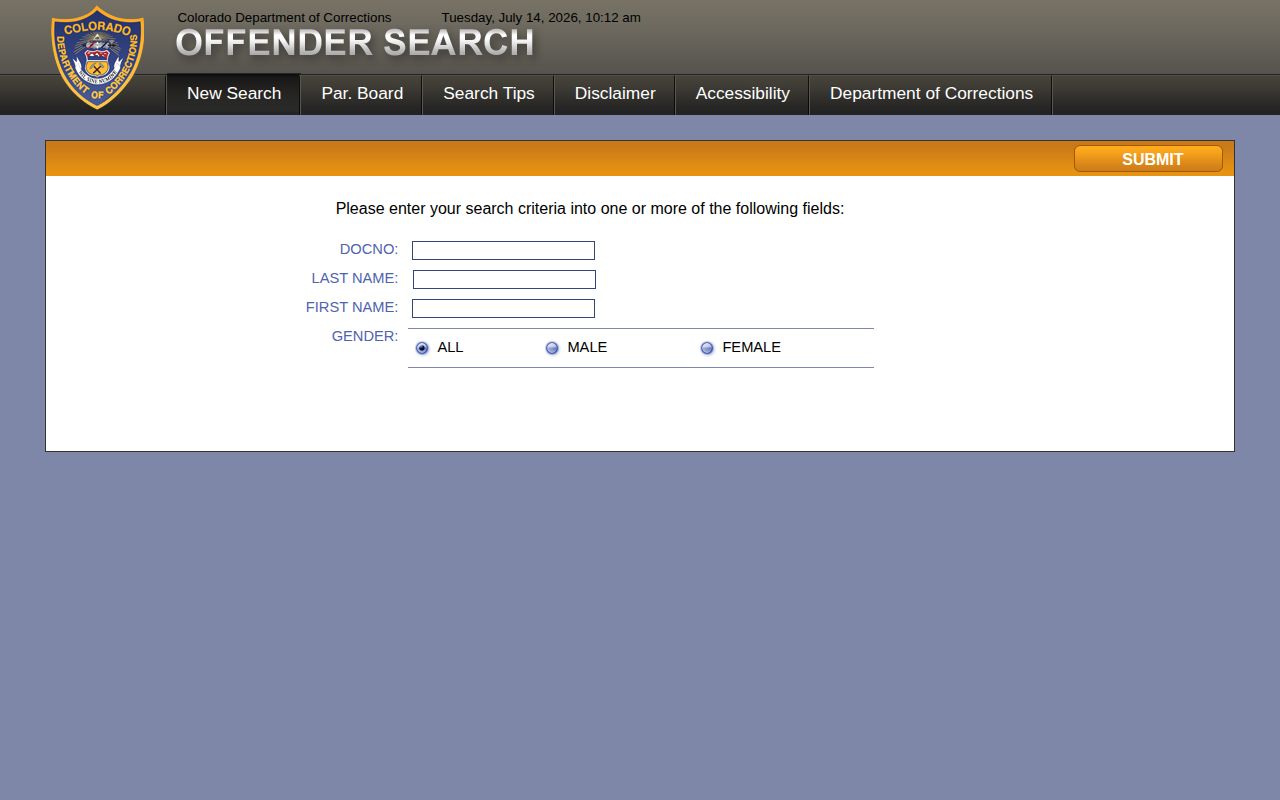
Use the search result as a state corrections record, then compare it with court and parole information when the release date is affected by hearings or sentence changes.
Huerfano County Parole Eligibility Date
Colorado's most defensible projected-release concept from the research is Parole Eligibility Date, or PED. Under 8 CCR 1511-1, PED is the earliest possible parole release date. It is based on sentence length, time served, good-time credits earned or lost, and statute, as calculated by CDOC offender time and release operations.
PED is eligibility. It is not a guarantee. A person can remain in custody after PED if parole is denied, deferred, rescinded, delayed while a parole plan is reviewed, affected by discipline, or changed by sentence computation. A person can also leave on a different date because of mandatory release, statutory discharge, resentencing, court credit, or other lawful events.
- Parole Eligibility Date
- The earliest date a person may be eligible for parole consideration under CDOC computation.
- Mandatory release
- A release tied to statute and sentence structure, not just a parole-board approval.
- Discharge
- The end of the sentence or supervision obligation in the relevant system.
- Detainer
- A hold or notice from another agency that may affect release from one custody system.
The parole-board calendar helps explain the timing of hearings, but it does not by itself prove release. The calendar can show that a case is scheduled for review. The offender record and official parole channels must still be checked for the result, the real release status, and any later rescission or revocation event.
Colorado Earned Time and Dates
C.R.S. section 17-22.5-405 is the earned-time statute identified in the research. It authorizes earned time of up to ten days per month for incarceration or parole when progress is demonstrated and certified. It also authorizes up to twelve days per month for certain lower-level felony or drug-felony categories when statutory criteria are met.
CDOC may grant, withhold, withdraw, or restore earned time after reviewing performance records. That is why a Huerfano County projected release date in a state-prison record can change. The date is not just arithmetic on the sentence length. It also reflects credits, discipline, offense class, offense date, parole-board action, and controlling law.
Colorado percentage-service rules should not be reduced to a single sentence. Some categories have different parole eligibility structures, and recent violent-felony changes involved an 85 percent threshold for covered future cases. The safe public-record answer is to read the CDOC date label, court sentence, and current law for the specific person.
Do not move CDOC earned-time rules into a Huerfano County Jail sentence without a source. The research did not find a local jail policy that states how a short county sentence is credited. For local custody, the court order and sheriff release record control the practical answer.
Huerfano County Jail Release Date
A local jail release date is not computed the same way as a CDOC prison date. For the Huerfano County Jail, a release may come from bond, time served, sentence completion, a court order, transfer to CDOC, transfer to another county, federal transfer, immigration custody, or a hold being cleared. The sheriff record shows the custody event. The court record explains many of the legal reasons.
No public local good-time policy or weekend-release policy was found in the official Huerfano County sources reviewed. Do not infer local jail credits from another county's rules or from CDOC earned-time law. If the person is serving a local sentence, ask the jail or sheriff records unit for the release date and the court for the sentence, mittimus, bond order, or confinement credit.
Note: A person can leave the county jail by transfer and still remain in custody under another agency.
Huerfano County Court Date Clues
The court record can explain why a projected date changed or why there was never a set date. The Huerfano County Judicial Center is the local court source for county and district criminal cases. A docket or Register of Action may show bond, personal recognizance release, dismissal, sentence, mittimus, probation, revocation, or transfer to CDOC. Those entries do not always give the physical jail release timestamp, but they explain the order behind the custody event.
The Colorado Judicial Branch docket search requires at least one filter in addition to date. Use a case number where possible. If the arrest began in Walsenburg, remember that Walsenburg Municipal Court handles certain city ordinance and misdemeanor matters, while DUI and felony cases are written into County and District Combined Court. The projected release date question may therefore require both custody and court routing before the correct source is clear.
A court date on its own is not a release date. A bond hearing may lead to release only after the jail receives and processes the order. A sentencing entry may lead to time served, probation, or transfer. A mittimus may send the person to CDOC instead of releasing the person to the community. Pair the court entry with the jail or CDOC record before relying on the date.
Why Huerfano County Release Dates Change
Projected dates move because custody records are live administrative records. A court order can change a county jail release. CDOC can recalculate state time. A parole decision can change the practical release date. Another agency can place a hold. Federal and immigration custody can create a separate next step after local release.
Transfers are a common source of confusion. A jail may record a release from Huerfano County custody because the person physically left the jail, but the next record may show CDOC, BOP, ICE, another county, or another court process. In that situation, the county release date and the final release-to-community date are two different records.
| Factor | How It Can Change the Date | Where to Confirm |
|---|---|---|
| Earned time | CDOC can grant, withhold, withdraw, or restore credits under Colorado law. | CDOC offender record or CDOC records channel |
| Parole hearing | Eligibility may not become actual release if parole is denied, deferred, or rescinded. | CDOC offender search and parole-board calendar |
| Court order | Bond, sentence credit, resentencing, dismissal, or mittimus can change local custody. | Huerfano County Judicial Center |
| Hold or detainer | Another agency may take custody after the local jail release event. | Sheriff record and receiving agency |
| Federal recalculation | BOP warns federal dates can change because of sentence review and federal time credits. | BOP inmate locator and BOP records |
Confirm Huerfano County Release Date
Use the strongest source for the specific release. For a Huerfano County Jail release, use the sheriff's jail or records channel. For the legal reason behind the release, use Huerfano County Combined Court. For a state-prison date, use CDOC. For a parole hearing, use the parole-board calendar plus the offender record. For a federal sentence, use BOP. For immigration custody, use ICE.
BOP records from 1982 forward can show federal release dates, and BOP explains that a past release date with no facility means the person is no longer in BOP custody. That rule is useful for federal cases, but it does not certify a Huerfano County jail release. Likewise, CDOC records cannot certify a county jail timestamp unless the record describes a state custody event.
VINELink can supply a practical alert when a participating custody status changes. It should be paired with the record source. For a named-person search across all paths, use Huerfano County released inmates to reconcile sheriff, court, CDOC, VINE, BOP, and ICE records.
When the sources disagree, treat the newest official custodian as the next point of contact. A sheriff record can show release to CDOC, but CDOC then owns the prison date. CDOC can show parole eligibility, but the parole record explains whether release was approved. BOP can show a federal date, but a local Huerfano County record may only show that the person was held or transported locally before federal custody took over.
Keep a short source trail when checking a date: search result, court entry, records request, and any notification. The labels matter more than the reader's guess about the outcome. Released, discharged, parole eligible, transferred, sentenced, and not in custody each point to a different records owner and a different next step.