
Huerfano Court Release Records
The Huerfano County Judicial Center is a records source, not a jail. The sheriff records show the custody side of a release: booking, release date, release type, and transfer where releasable. The court record explains the legal side: bond, personal recognizance, dismissal, sentence, probation, revocation, mittimus, or other order. Both can be needed because a jail release timestamp does not always explain why the person left custody.
This court source is especially important in Huerfano County because no official sheriff public recent-release feed was found in the reviewed sources. When a person is not visible in a current custody source, the court case may be the most durable public record. It can show whether the person was released on bond, sentenced to probation, sentenced to CDOC, had a case dismissed, or had a warrant or revocation issue that changed custody status.
| Record question | Likely court value |
|---|---|
| Why did the jail release occur? | Bond order, dismissal, sentence, or mittimus |
| Did supervision follow release? | Probation order or revocation docket entry |
| Was the person sent to prison? | Sentence and transfer order leading to CDOC |
| Is the case still open? | Docket status, future hearing, or closure entry |
Judicial Center Contact
The official court location page lists the Huerfano County Judicial Center at 200 West 5th Street, Suite 141, Walsenburg, CO 81089. The phone is 719-793-7100 and the fax is 719-738-5717. Hours are Monday through Friday, 8:00 a.m. to noon and 1:00 p.m. to 4:00 p.m. The research also notes jury, collections, and telephone payment contacts, but release verification usually starts with the docket, record search, or clerk contact for the relevant case.
Huerfano County Judicial Center
200 West 5th Street, Suite 141
Walsenburg, CO 81089
Phone: 719-793-7100
Fax: 719-738-5717
Hours: Monday-Friday, 8:00 a.m.-noon and 1:00 p.m.-4:00 p.m.
The court should not be asked to certify the physical time someone walked out of the jail. That fact belongs to the sheriff's booking and release record. The court can confirm the order or disposition that caused the release, the sentence that followed, or the probation status that began after the jail stay.
Huerfano Court Source Image
The matched screenshot from the Huerfano County Judicial Center page supports the court address, phone, fax, and hours used for release-record routing.
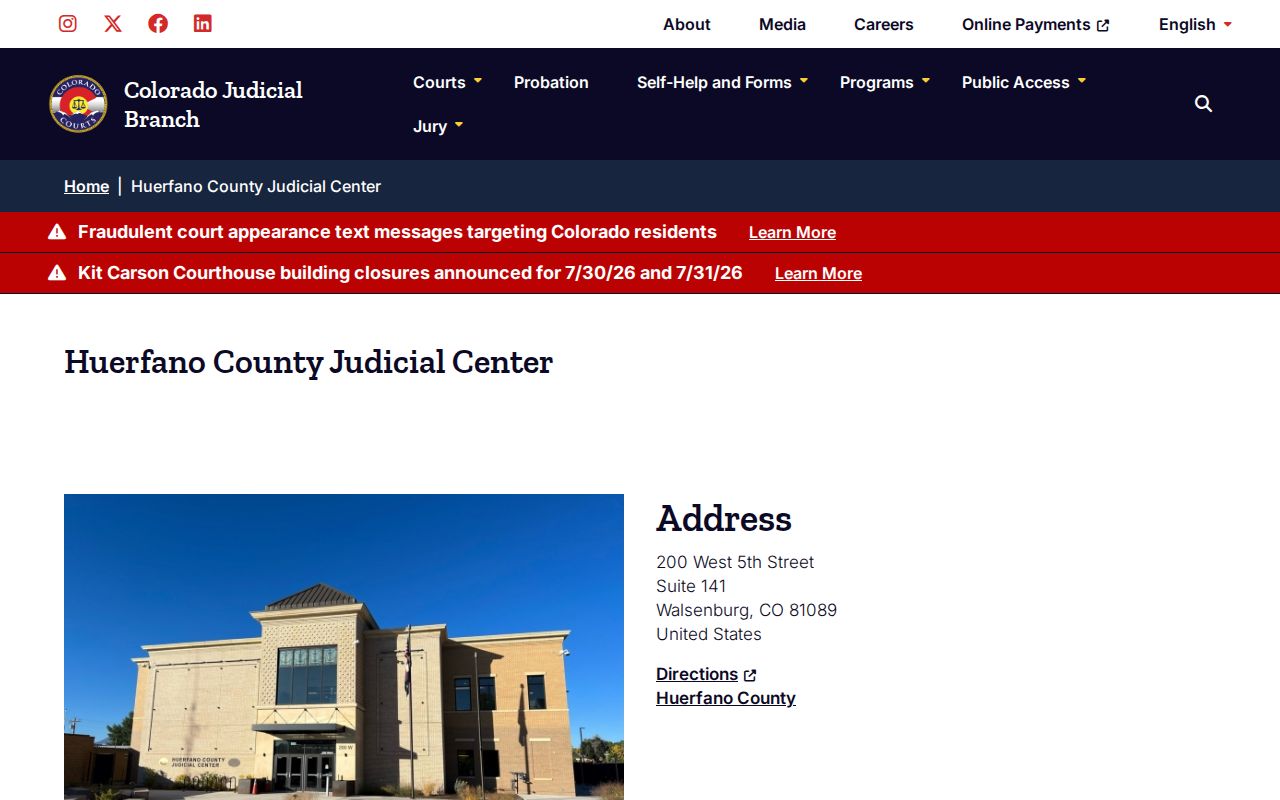
The source confirms court access details. It does not convert the Judicial Center into a detention facility or a jail roster.
Search Huerfano Court Records
The Colorado Judicial Branch docket search requires at least one filter in addition to date. A date-only search is not enough. Use a case number if known, or use party name and county/court filters where available. The Huerfano County trial-court page also links record search request resources, a weekend bond hearing schedule, online payments, collections, and other court tools.
- Start with the case number if the sheriff release record, citation, bond paperwork, or notice provides it.
- Use party name and Huerfano County filters when the case number is unknown.
- Check docket entries for bond, release order, disposition, sentence, probation, revocation, or transfer language.
- Request court records when the public docket does not show enough detail.
- Compare the court result with sheriff, CDOC, BOP, or ICE records depending on the custody path.
Walsenburg Case Routing
Walsenburg Municipal Court creates a local routing issue. Its page states that municipal court handles traffic, parking, animal, vehicle-document, and misdemeanor criminal offenses within Walsenburg city limits. It also states that DUI and felony cases are written into County and District Combined Court. A person arrested in Walsenburg may therefore have a municipal ordinance case, a county-court misdemeanor, a district-court felony, or more than one case path.
For a release search, that means the arresting location does not always identify the court record. If the event involved DUI or a felony, check Huerfano County Combined Court even if the incident began within city limits. If it was a city ordinance matter, municipal records may matter too. The jail release record and court case should be read together before deciding which record explains the custody event.
Court Record Limits
A court docket showing bond or dismissal does not prove the exact minute the jail released the person. A sheriff release record showing transfer does not prove the court case is finished. A closed criminal case does not always mean supervision has ended. Sealed, juvenile, and restricted records can also limit public results. When a public search produces little or no information, the answer may be restricted access rather than no case or no release.
For correction requests, contact the custodian that created the record. The sheriff handles jail booking and release records. The court handles dispositions and sentence records. CDOC handles state offender fields. BOP handles federal release dates. ICE handles immigration custody records. Separating those custodians is the strongest way to verify a Huerfano County release without overreading one record source.
Court records also have timing limits. A bond order can be entered before jail staff finish release processing. A sentence can be imposed before transport to CDOC occurs. A probation order can exist while intake or reporting instructions are still being arranged. For a same-day release question, the jail line remains the better current-status contact. For the durable legal reason, the Judicial Center and docket are stronger.
Requesting Court Release Records
When the public docket is too thin, ask for the specific court record rather than a broad file search. Useful terms include bond order, minute order, disposition, sentence, probation order, revocation order, mittimus, and case closure. Provide the case number if known. If the case number is unknown, use full legal name, approximate date, court, and county filters. The Huerfano County trial-court page links record search resources that can help identify the correct record path.
CoCourts is described in the research as a Colorado Judicial Branch initiative that can provide a Register of Action on court-record searches. It can help identify a case history, but official local contact still belongs to the Judicial Center for copies and local clerk questions. If a sheriff record and court record point in different directions, ask each custodian about its own record instead of asking one office to interpret the other's files.
The 3rd Judicial District context also matters. Huerfano and Las Animas counties share the district, with Huerfano court operations in Walsenburg. Use Huerfano County filters when the release event came from a Huerfano booking, but do not ignore another county or municipal case if the docket or charging agency points there.
Build a Court Release Timeline
A court timeline explains why a jail stay ended. Start with the case number or party name, then identify the court, charge level, bond order, hearing result, sentence, dismissal, probation order, mittimus, revocation, or closure. The court record can show the legal event that authorized release or transfer. The sheriff record then confirms the physical custody timestamp.
When the court and jail records appear to differ, ask what each record is measuring. A docket may show that bond was set or posted before the jail completes release. A sentence entry may show credit for time served without giving the exact time the person walked out of jail. A mittimus can explain a transfer to CDOC even when the county jail record simply shows the person left local custody.
Huerfano County's court routing makes this extra important. Walsenburg municipal matters, county misdemeanors, and district felonies can point to different docket paths. DUI and felony matters are routed to County and District Combined Court, so a local arrest can still require the Judicial Center record even when the first contact happened inside city limits.
For copies, use the court's record request path rather than asking the jail for court paperwork. The sheriff can document custody, but the Judicial Center controls court filings, docket history, sentencing, probation orders, and case closure records. If a public docket result is limited, contact the court with the case number or party information and ask which record request process fits the document needed.
That court-first approach is also useful when a person was released on a weekend bond setting or after a short hearing. The jail may know the custody status, but the court record explains the order that authorized it.
Public Record Search
Sponsored Results