
Colorado Parole Release Path
The Colorado State Board of Parole and CDOC Adult Parole function belong to the state-prison release path. A Huerfano County defendant may reach this path after sentencing to CDOC, serving part of a prison sentence, and reaching a parole eligibility or release-related decision point. That is different from probation, which is a court supervision status, and different from a county jail release on bond or time served.
The parole board calendar can show hearing schedules, but a hearing is not the same as release. A person may be granted parole, denied parole, deferred, continued, rescinded, revoked, or returned to custody. Actual release and supervision status should be reconciled with CDOC offender search, parole-board information, and any official supervision record. Huerfano County jail records can show only the local custody event before state prison, not the later parole outcome.
| Term | Meaning for release checks |
|---|---|
| Parole eligibility | Earliest possible parole consideration date, not guaranteed release |
| Parole hearing | Board event that may affect release or supervision |
| Parole release | Leaving prison to state supervision |
| Discharge | End of sentence or supervision as shown by the custodian |
Parole Calendar Source
The CDOC parole-board calendar is reached from the offender search environment. The reviewed research describes a calendar-based page with month views. It says users can hover over a date for that day's schedule and click a calendar title for a larger calendar. The page reviewed showed current and upcoming months, but the build should not claim a fixed weekly or monthly publication cycle unless an official source states one.
The matched screenshot from the parole-board calendar source shows the public calendar interface used for hearing research.
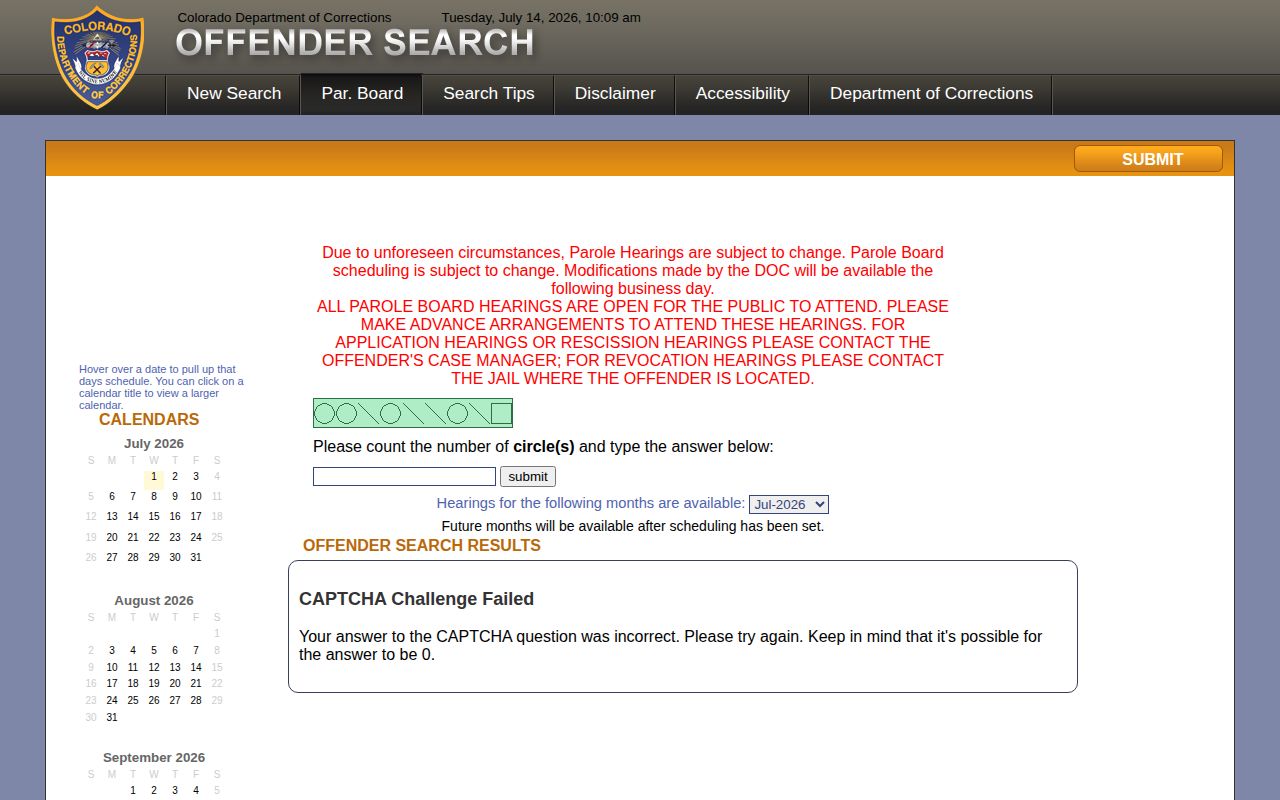
The calendar helps identify a hearing schedule. It should be paired with CDOC offender status before treating a person as released, still in custody, or on parole.
Verify Huerfano Parole Status
A Huerfano County parole check should begin with whether the person was sentenced to CDOC. If the person was never in state prison, the parole board is probably the wrong source. For a state-prison case, search CDOC first because the offender record can provide identity, custody status, parole eligibility date, and release or discharge labels. Then use the calendar if the question involves a hearing.
- Search CDOC by DOCNO when possible, or by name and gender.
- Confirm that the person and state record match the Huerfano County case or sentence.
- Read the CDOC status and date labels exactly as shown.
- Use the parole-board calendar for scheduled hearings connected to that record.
- Reconcile hearing information with actual CDOC release, parole, or discharge status.
Do not treat a board calendar listing as proof that the person left prison. The calendar is a schedule source. The release record is the custody-status and supervision record maintained by CDOC and parole authorities.
Parole Is Not Probation
Huerfano County Probation is a local judicial supervision source at the Huerfano County courthouse location. Probation can follow a jail release without any prison sentence. Parole follows state prison. That distinction matters because many people use the terms loosely after release. A person released from the Huerfano County Jail on bond may have bond conditions, court dates, or pretrial supervision, but that does not make the person a parolee.
For probation, use the court docket, Huerfano County Probation, and court record requests. For parole, use CDOC offender search and parole-board or Adult Parole channels. If the record says "absconder," "revocation," "warrant," or "return to custody," the source matters. A court warrant, sheriff warrant, state parole complaint, and federal warrant are different legal paths and should be verified with the agency that issued or manages the status.
Parole Eligibility Date
Colorado's Parole Eligibility Date is a release-related date, not a promise of release. Research points to 8 CCR 1511-1 for the definition: PED is the earliest possible parole release date, established by sentence length, time served, good-time credits earned or lost, and statute, as calculated by CDOC offender time and release operations. C.R.S. section 17-22.5-405 supplies the earned-time framework that can affect date computation.
A person may pass PED and remain in prison because the board denied or deferred parole, a parole plan needs review, a rescission or revocation issue exists, or sentence computation changed. A person may also leave custody under a mandatory release or discharge structure instead of discretionary parole. For a Huerfano County case, the court explains the sentence, while CDOC and parole authorities explain state release timing.
Parole Records and Contacts
The public starting points are the CDOC offender search and the parole-board calendar. Huerfano County's local court is still relevant because it can identify the sentence, county of conviction, and case history that led to CDOC. The sheriff is relevant only for the local jail transfer or release timestamp before prison custody. A release from CDOC to parole should be confirmed through the state record, not through a county recent-release feed.
When the parole status appears inconsistent, request clarification from the custodian of the record. CDOC handles state offender records and release-date fields. Parole authorities handle board and supervision records. The court handles sentence and case disposition records. The Huerfano County Sheriff's Office cannot correct a state parole date, and the parole board cannot correct a county booking timestamp.
Huerfano County also has a practical local supervision split. Probation questions can be routed to the Walsenburg probation office at the courthouse location when the court record shows probation. Parole questions stay with CDOC and Adult Parole because they come after prison. A released person may have bond conditions, probation terms, parole terms, or no supervision, and those are different statuses. Read the court docket and CDOC record before calling an office.
Parole Outcome Terms
Parole outcome words should be read literally. Granted or approved suggests the board allowed parole subject to the required plan and release processing. Denied means the board did not approve parole at that point. Deferred or continued means the issue may return later. Rescinded means a prior approval may have been pulled back before release. Revoked means a person on parole may be returned to custody after a violation process. None of those terms should be translated into a Huerfano County jail release unless the county record independently supports it.
If only a hearing date is known, search CDOC again after the hearing window and compare the status fields. The calendar helps locate the event; the offender record and official records channels carry the custody result.
Build a Parole Release Timeline
A parole timeline starts with CDOC custody, not with a Huerfano County jail bond release. The county case may explain why the person entered state prison, but the parole board and CDOC records explain eligibility, hearings, release to parole, supervision, revocation, and discharge. A Huerfano County jail record may reappear only if the person is later held locally on a warrant, transport, or another local booking.
Use the CDOC offender search to identify the person and current state status. Then use the parole calendar to check whether a hearing is scheduled. After that, reconcile the calendar entry with the offender record and any official parole or supervision information. A scheduled hearing does not guarantee release, and a parole eligibility date does not mean the person left custody on that date.
For local practical questions, keep probation separate. Huerfano County Probation is the local court-supervision office. Parole is post-prison supervision through the state system. If the court docket shows probation rather than a prison sentence, the local probation office and court record are the better sources.
The parole calendar should be treated as a scheduling aid. It can show that a hearing is set or appears on a month/day interface, but the custody answer still comes from the offender record, the board action, and the supervision status that follows. A Huerfano County family member may need all three pieces to understand whether release was approved, delayed, revoked, or followed by supervision.
When the public calendar does not answer the question, return to the CDOC offender record and the official parole channels. The calendar tells when a board event may occur. It does not replace the record that shows what happened afterward.
Public Record Search
Sponsored Results